



.jpg)
.jpg)
.jpg)

Follow us on
How to choose a coffee shop location in Paris , and why most people get it wrong
You've found a space. The neighborhood feels right. You love the street. Your gut says yes.
Now ask yourself: how many people walk past that door on a Tuesday at 9am? Where do they come from? Are they commuters grabbing a flat white before a meeting, or locals on a weekend stroll? How many of them will come back tomorrow?
If you can't answer those questions before signing a lease, you're making a €50,000+ decision on instinct. In Paris, that's a gamble you can't afford.
The French coffee shop market has grown 74% since 2010, according to the Collectif Café, with retail sales up 140% over the same period. Demand is real. But so is the competition. Between 50% and 74% of independent coffee shops close within their first five years , and the most commonly cited reason isn't poor coffee. It's poor location choice.
To understand what separates a thriving address from a costly mistake, we analyzed three Paris coffee shops using Gini by Mytraffic: Café d'Auteur (6th arr.), Partisan Café Artisanal (3rd arr.), and Café Nuances Vendôme (1st arr.). The numbers tell a story that gut instinct never could.
Why is foot traffic volume not enough on its own?
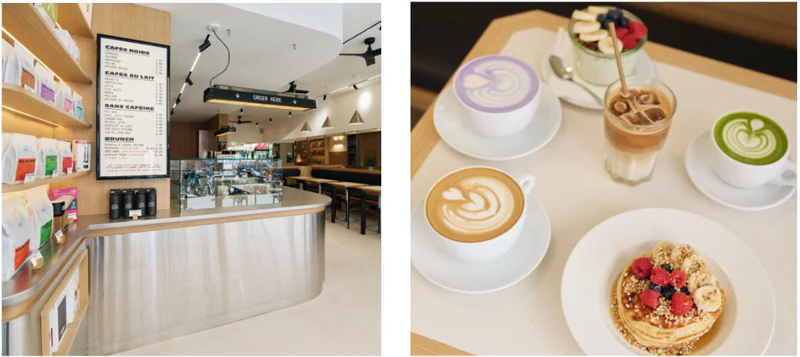
The obvious answer to "what makes a coffee shop location work?" is foot traffic. More people walking by = more potential customers. That's true , but it's only half the picture.
Our analysis of three Paris coffee shops showed that Café Nuances Vendôme has 3.3 times more daily pedestrian flow than Partisan Café Artisanal. On the surface, that sounds like a clear winner. But the more interesting question is: who are those pedestrians, and what do they want?
In the case of Café Nuances Vendôme, located near the office clusters of the 1st arrondissement, 20.8% of visitors come to the area specifically to work , nearly three times the figure for Café d'Auteur in the 6th (7.3%). That's not just a demographic curiosity. It shapes everything: peak hours, average transaction size, dwell time, and what you need on the menu.
A coffee shop near offices lives or dies by the morning rush and the lunch window. One in a more residential or cultural neighborhood runs on a different clock entirely , slower mornings, longer weekend stays, different spend patterns. The location doesn't just determine how many people come. It determines what kind of business you're actually running.
The takeaway: Before you evaluate any address, ask what kind of coffee shop the location demands. The street will answer that question for you , if you know where to look.
What are the 5 signals that actually predict coffee shop success?
High foot traffic is necessary but not sufficient. These are the signals that, combined, give you a real picture of a location's potential.
1. Daily flow volume, and how consistent it is across the week
The raw pedestrian count matters, but consistency matters more. A street that peaks at 30,000 daily visitors on Saturday and drops to 4,000 on Tuesday is a different business from one that holds 15,000 daily visitors Monday through Friday.
Urban foot traffic research consistently shows that weekday patterns in office districts follow a predictable three-peak structure: morning commute (around 9am), lunch hour (noon to 1pm), and evening commute (around 5pm). Retail and residential neighborhoods behave very differently , foot traffic builds gradually through the morning and peaks later in the afternoon, particularly on weekends.
For a coffee shop, weekday consistency is often more valuable than weekend spikes. A steady Monday-to-Friday flow of office workers funds the business. Weekend traffic is a bonus, not a business model.
What to look for: Count pedestrian volume at your shortlisted address on a Tuesday morning, a Wednesday lunch, and a Saturday afternoon. If all three are strong, you have a location. If only one is, you have a concept that works one day a week.
2. Visitor purpose, why people come to the area
This is the signal most operators ignore, and it's the one that determines your entire offer strategy.
Our Paris data is instructive: Café Nuances Vendôme, surrounded by offices and corporate headquarters in the 1st arrondissement, attracts 20.8% of visitors who are in the area to work. Partisan Café Artisanal in the 3rd, a more mixed residential and cultural district, draws 11.4%. Café d'Auteur in the quiet Left Bank 6th, just 7.3%.
That gap has direct business implications. A location with 20%+ work-purpose visitors rewards a coffee shop that runs fast, serves reliable espresso, has strong wifi, and possibly offers a short lunch menu. A location with low work-purpose traffic and high leisure footfall rewards slower service, a more atmospheric space, and weekend specials.
Getting the purpose wrong, opening a fast-commuter concept in a leisure neighborhood, or a slow brunch spot in a business district, is one of the most common and expensive mismatches in hospitality. The footfall is there, but it's the wrong footfall for what you're selling.
3. Catchment area and visitor origin
Where do your future customers actually live?
In our Paris study, each coffee shop drew from strikingly different catchment areas. Visitors to Café Nuances Vendôme came predominantly from the 9th, 17th, and 18th arrondissements. Partisan Café Artisanal drew mostly from the 3rd itself, a tighter, hyperlocal base. Café d'Auteur pulled from the 5th, 6th, and 14th.
This has two strategic implications. First, it tells you how loyal your customer base can be. A tight catchment (mostly local residents) means high repeat visit potential, these people walk past your door every day. A wide catchment (visitors from multiple arrondissements) means more discovery traffic but less automatic loyalty.
Second, it tells you where to spend your marketing budget. If 60% of your visitors come from two arrondissements, that's where your flyers, Instagram geo-targeting, and local partnerships should focus.
What to look for: Understand not just who passes your door, but where they come from and how far they travel. A location that draws visitors from a 5km radius is a destination. One that draws from a 500m radius is a neighborhood fixture. Both can work, but they require different positioning.
4. Visitor demographics, age, income, and lifestyle profile
Here's the counterintuitive finding from our Paris study: despite sitting in very different parts of the city, all three coffee shops attracted visitors with a remarkably similar profile , around 39 years old, with approximately €46,000–€49,750 in annual disposable income.
The Left Bank/Right Bank income gap, which many operators assume is dramatic, was actually modest across these three locations. This suggests that in Paris, the specialty coffee shop concept has converged on a specific urban professional demographic regardless of neighborhood , and that demographic is broadly similar across the city's inner arrondissements.
What differs is lifestyle and intent, not wealth. A 39-year-old with €48,000 in disposable income visiting the 1st arrondissement on a Tuesday morning wants something different from the same person visiting the 6th on a Saturday afternoon. The demographic is consistent. The context is not.
What to look for: Don't just check whether your target demographic lives nearby. Check what they're doing when they're nearby. That context shapes your offer more than any income bracket.
5. Competition density, and what it actually tells you
The naive view of competition: fewer coffee shops nearby = better opportunity. The more sophisticated view: competition density is a signal of proven demand.
Starbucks has built its global expansion strategy around this principle , they deliberately open near competitors, because competition confirms that the market exists and is active. An area with zero specialty coffee shops might mean untapped opportunity. It might also mean the demand isn't there.
The useful metric isn't just "how many coffee shops are within 300 meters?" It's "how busy are they?" A street with three packed coffee shops tells you the demand is real and growing. A street with one struggling café tells you to ask why.
Beyond counting competitors, analyzing how their visitors behave , where they come from, how long they stay, what time of day they peak , gives you a detailed picture of the environment's commercial potential and whether there's a gap your concept could fill.
What to look for: Visit your competition at three different times of day. Are they full? Who's sitting there? What are they ordering? That reconnaissance, combined with actual footfall data, tells you whether there's room for you , or whether you'd be fighting over the same customers with a weaker offer.
How do you analyze a location before signing?

Most operators spend a few hours walking the street, maybe count pedestrians manually for 20 minutes, and then decide. That approach worked in 2005. Today, with 74% more coffee shops competing for the same customers, it's not enough.
The smart approach works in two steps.
Step one: define your success criteria before you look at addresses. What daily foot traffic volume do you need to be profitable? What visitor purpose profile fits your concept? What catchment radius makes sense for your business model? Write those numbers down before you visit a single space. Otherwise every space feels promising when you're standing in it.
Step two: test each shortlisted address against those criteria with real data. This is where Gini by Mytraffic changes the equation. Instead of spending weeks commissioning a location study or relying on instinct, you can analyze any address in minutes , pedestrian flow, visitor origin, demographic profile, competition density, purpose of visit. The same data used in this article, applied to your specific shortlist.
Think of it as reading the Place DNA of a location. Every street has a rhythm, an audience, a purpose. Gini makes that visible before you commit.
Café Nuances Vendôme's success isn't accidental. Its proximity to office buildings produces consistent weekday mornings, a work-motivated customer base willing to spend regularly, and a catchment that refreshes daily with new commuters. That's not something you discover by standing on the corner for an hour. It's something you read in the data.
To resume
In Paris, choosing a coffee shop location isn't just a real estate decision. It's the first strategic choice you make about what kind of business you're building.
The right address tells you your opening hours, your menu priorities, your price point, your marketing radius, and your staffing model. The wrong address makes all of those things harder, no matter how good your coffee is.
The data is there. The question is whether you read it before or after you sign.
Ready to analyze your shortlisted addresses? Start a 14-day free trial with Gini by Mytraffic and get the full location picture, foot traffic, visitor profiles, competition, catchment, in minutes.